
CREATE Health – advancing science with new instruments
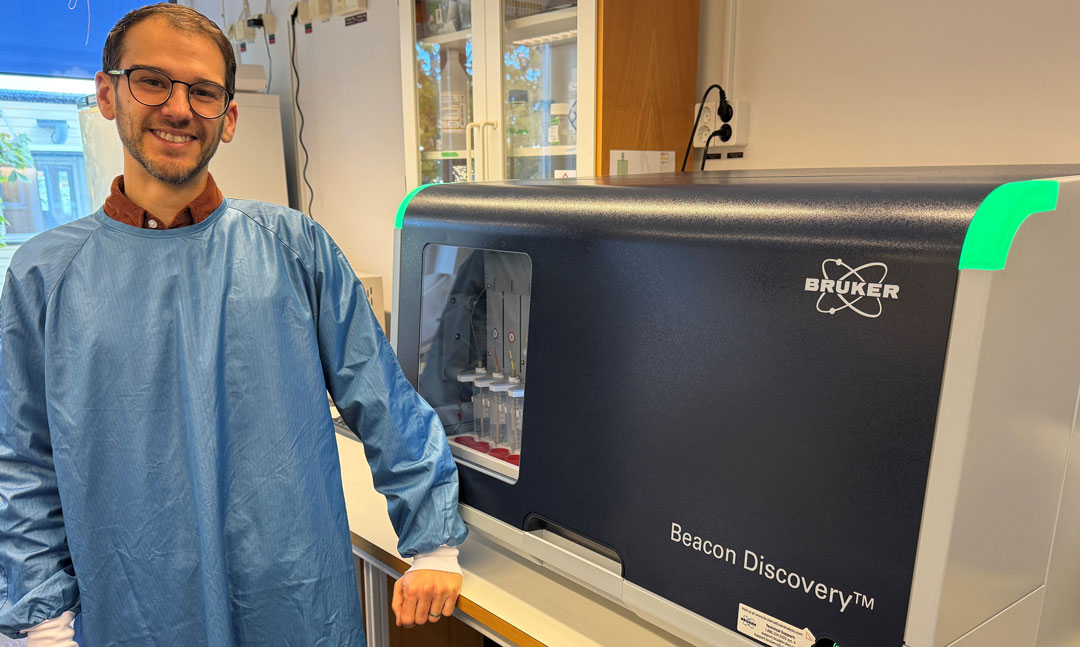
A major donation has enabled Medicon Village member CREATE Health to invest in cutting-edge equipment, such as the Beacon optofluidic system. While there are several Beacon systems across Europe, CREATE Health’s is the only one focused on T-cell profiling workflows and is the latest generation of the instrument.
The Beacon is an automated platform for studying the function of individual living cells. It uses light based Opto-Electrical Positioning to guide selected cells into tiny, isolated NanoPen chambers on a microfluidic chip. There, cells can be cultured, imaged and tested with functional assays, while researchers track their responses over time.
By bringing cell handling, live-cell imaging and functional testing together, the Beacon helps researchers find cells with specific properties in large and diverse populations. Selected cells can be recovered for further work, such as sequencing, so their observed behaviour can be connected with downstream molecular analysis. Depending on the chip and workflow, the system can support applications including T-cell profiling, antibody discovery and cell line development.
What makes the Beacon system distinctive?
Many single-cell methods capture a snapshot or focus on a limited set of markers. The Beacon is designed to follow what living cells do: researchers can observe and assay individual cells over time, then recover selected cells for further analysis. Its combination of light based cell positioning, small perfused chambers and live-cell functional readouts supports parallel experiments while keeping cells accessible for follow-up work.
Beacon can support several kinds of live single-cell functional workflows. The common pattern is to isolate individual cells in tiny NanoPen chambers, culture and image them, run one or more assays, then recover selected cells for further analysis. The exact options depend on the Beacon model, chip, reagents and assay setup:
- Antibody discovery and profiling: screen B cells for antibody secretion and function, including antigen specificity, relative affinity, cross-reactivity, ligand blocking and binding to cell-surface targets.
- T-cell profiling and cell therapy research: assess cytokine secretion, surface markers, phenotype and killing of target cells; investigate cell–cell interactions and identify cells for TCR/CAR or sequencing follow-up.
- Cell line development: isolate and evaluate clones for growth, productivity and other selected properties, then recover promising live clones.
- Custom functional assays: depending on the assay design, study secretion, fluorescence, proliferation, morphology, motility or interactions between cells.
A useful feature across these workflows is the ability to collect time-resolved information from the same living cell, and in some workflows connect the functional result to downstream sequencing.
CREATE Health Translational Cancer Centre develops and translates cutting-edge diagnostic and therapeutic innovations into real-world clinical solutions that improve patient outcomes and advance public health. By combining state-of-the-art technologies – including AI-driven data analytics, next-generation sequencing, advanced molecular imaging, precision biologics and targeted delivery systems – CREATE Health accelerates discovery, validates efficacy in clinical settings and helps bring scalable solutions to patients and society. CREATE Health celebrates its 20th anniversary in 2026.
In 2025, Medicon Village member CREATE Health received a SEK 420 million donation from the Mrs Berta Kamprad Cancer Foundation – the largest single donation to Lund University since its founding in 1666. Distributed over five years, the funding is dedicated to translational cancer research within the L2CancerBridge programme. It enables CREATE Health to invest in cutting-edge equipment, including the Beacon optofluidic system.
More on CREATE Health via https://www.createhealth.lth.se/start, and the Beacon system via https://www.createhealth.lth.se/research/technologies/beacon-optofluidic-platform. To discuss your project and access the platform, please contact Steven Reid (steven.reid@immun.lth.se).
Pictured: Steven Reid