
10XHealth: Module 5 on “Regulatory Strategy and Commercialisation”
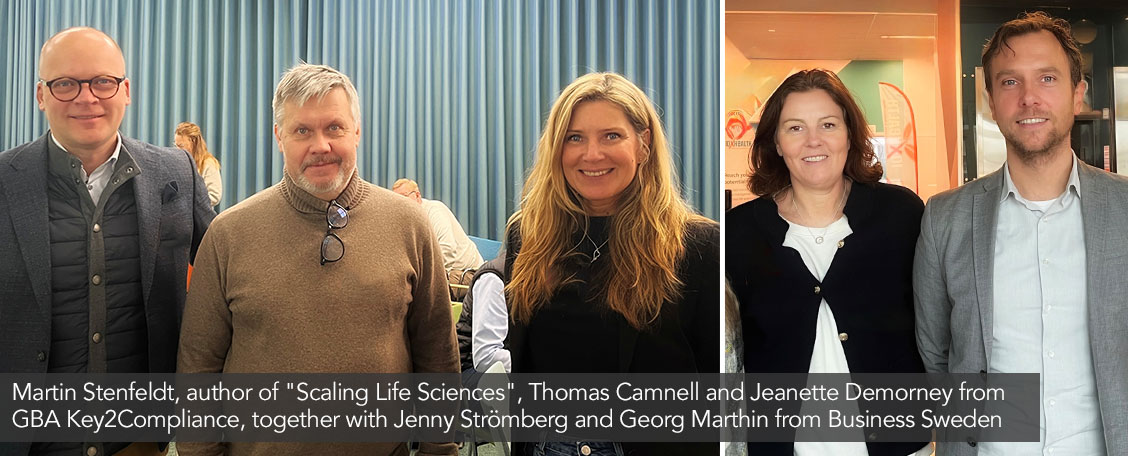
Last Tuesday, together with SmiLe Venture Hub, we organised Module 5 of our accelerator programme, 10XHealth. C-level leaders from our seven participating companies joined us to explore Regulatory Strategy and Commercialisation, expertly guided by Thomas Camnell and Jeanette Demorney from GBA Key2Compliance, Jenny Strömberg and Georg Marthin from Business Sweden, as well as Martin Stenfeldt, author of Scaling Life Sciences, who shared lessons learned from more than 150 industry practitioners.
In this module, participants learned how to address key considerations when entering specific life science markets, including regulatory and reimbursement perspectives. They also gained insights into enabling a flexible market access strategy and what to keep in mind when navigating different decision pathways.
Module 5 key takeaways:
- Regulatory aspects for executives and strategies for market access
- Primary considerations and low-hanging fruit when entering a major market
- Opportunities and challenges in specific markets
- How to leverage your company’s current assets and position, and build commercial partnerships
- Finding a successful route to market based on industry experience and key learnings
Key expert insights
Here are some key insights from the participating experts following Module 5, focusing on the main challenges scale-ups face in their areas of expertise and how to tackle them:
Thomas Camnell, GBA Key2Compliance:
- Make sure you have a clear business strategy, e.g. B2B or B2C. This will impact your regulatory strategy.
- Investigate potential market volumes for your innovation. Your choice of first markets will also shape your regulatory strategy.
- Update your risk management file throughout product development. New risks may arise along the way.
Jeanette Demorney, GBA Key2Compliance:
- Wearing only one hat. Clinical strategy is often built from a single perspective, rather than balancing regulatory, commercial and investor expectations. How to deal with it: Build the strategy wearing multiple hats at once, so the evidence supports a coherent story across regulation, market access and value creation.
- Confusing scientific credibility with regulatory readiness. Strong science and published data do not automatically translate into regulatory-grade, product-specific evidence. How to deal with it: Focus on traceable, product-specific evidence that clearly supports claims, performance and benefit–risk under the intended regulatory pathway.
- Discovering gaps too late. Critical evidence gaps are often identified late – during Notified Body review, due diligence or scale-up – when timelines and budgets are already under pressure. How to deal with it: Introduce clinical and regulatory strategy early, and continuously reassess benefit-risk as the product and business evolve.
Martin Stenfeldt, author of ”Scaling Life Sciences”
Commercialising life sciences is hard, especially for scale-ups. Launching a first product without an established brand, customer base or financial buffer is very different from rolling out a new product in a mature company. Ventures must build a sales force, set up customer success and complaint handling, secure supply chains and put governance in place – often all at once. It’s no surprise that first launches rarely hit a home run. Three recommendations for scale-ups:
- Hire sales leaders with strong networks of customers and sales representatives. Trusted relationships accelerate early traction and reduce time to scale the sales organisation.
- Establish a commercial advisory board. Outside-in perspectives from experienced commercial operators help management and boards stress-test internal assumptions and avoid costly missteps.
- Adopt staged commercialisation. Once regulatory approval, reimbursement and clinical evidence are in place, the temptation is to launch everywhere immediately. However, the cost of the wrong pricing, sales leader or customer support model is high. A phased approach allows learning first, and scaling efficiently once the right model is proven.
Over 10 months, these scale-ups are taking part in a tailor-made journey designed to accelerate life science innovation. The programme is powered by Medicon Village Innovation and SmiLe Venture Hub, and co-financed by the European Regional Development Fund.
More about 10XHealth can be found at: www.10xhealth.se.