
Hot topics at our 10XHealth accelerator programme
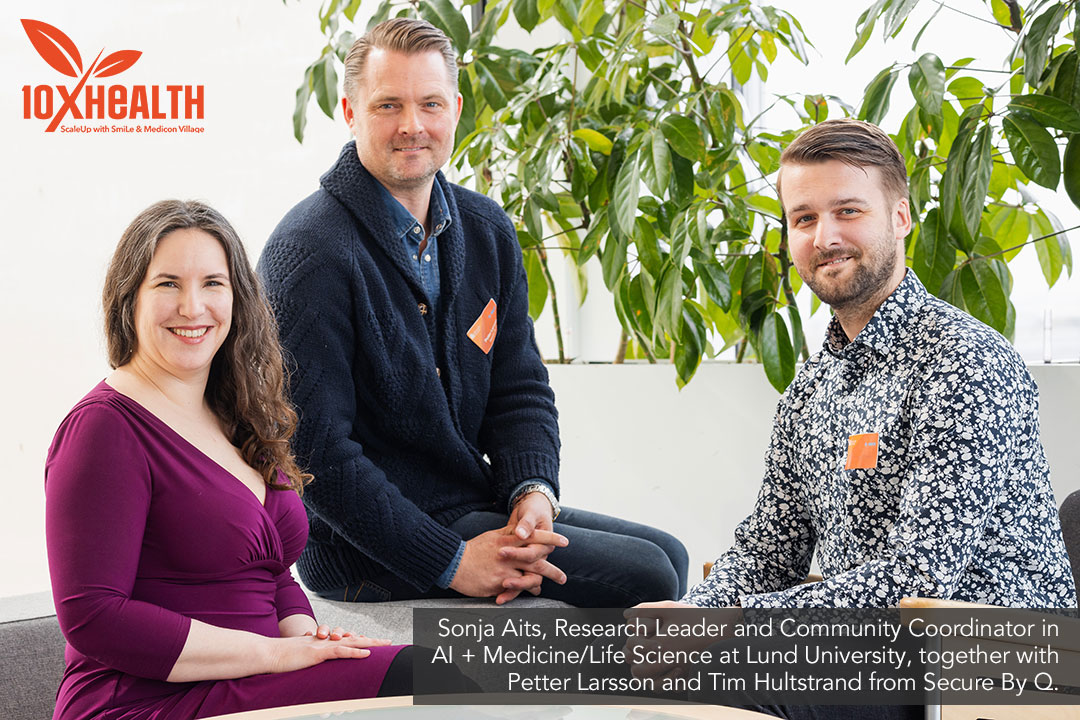
This week, we and SmiLe Venture Hub organised Module 7 of our accelerator programme 10XHealth. C-level leaders from our seven participating companies joined us to explore the theme “AI and cybersecurity for executives”, guided by Sonja Aits, Research Leader and Community Coordinator in AI + Medicine/Life Science at Lund University, Petter Larsson and Tim Hultstrand from Secure By Q, and Dennis Westerberg, lecturer and business coach specialising in AI.
In this module, participants learned how life science scaleups can harness two transformative aspects in digital technology – artificial intelligence and cybersecurity. The participants were given insights on the latest in the space, and room to apply both areas to address existing challenges or potential opportunities for their company.
This module's key takeaways:
- The latest in artificial intelligence and cybersecurity, focusing on the challenges an executive will encounter and have to navigate.
- How to start tackling both areas to address challenges or opportunities in your business, both in the short term and in the long term.
Here are some key insights from two of the participating experts in Module 7 on the main challenges scale-ups face in their areas of expertise, and how to tackle them:
Insights from Petter Larsson (LinkedIn)
- Cybersecurity is treated as something leadership allocate to IT, not a real active leadership responsibility on the C-suite agenda. That in itself is a strategic risk in the making. Solution: In a scale-up, everything competes for attention… growth, funding, product, hiring. Cyber risk gets pushed down. Until it doesn’t. Bring it into the leadership room and ask if we were the attacker; where would we go first, and how would that hit our growth, revenue, and valuation? Understand, and map your crown jewels and your real exposure. I bet they are many more than you initially grasp. That is where leadership ownership begins.
- Scaling faster than your ability to stay in control. Solution: You are adding people, tools, partners, and markets faster than your structures can keep up. Risk compounds quietly in the background. Define a few non-negotiables early (identity, access, backups, logging), assign clear ownership, and revisit them as you scale. You don’t need heavy frameworks first; you need control over what matters most.
- Compliance pressure without real capability. Solution: Customers, investors, and regulation start asking questions before you feel ready. The trap is building a “compliant surface” without real depth. Translate requirements into how you actually operate and pressure-test it. If we are hit tomorrow, who acts, how fast, and with what support? Capability is built in execution, not documentation. In experienced and felt principles, not checklists.
Most scale-up leadership teams I meet already sense it. A gap between the pace of growth and the level of control. It rarely shows up clearly, but it is there. When you expose your current state through an independent, structured lens, you don’t just see the risk, you see where to act, in what order, and without slowing down the business. To apply a skiing metaphor – if you want to ski the most advanced ski slopes, adopt your risk management accordingly, no more, no less. Ski fast, ski steep, ski safer.
Insights from Sonja Aits (LinkedIn)
One thing was clear: AI is now a priority for life science SMEs rather than a vaguely relevant secondary concern. Consequently, we had very lively discussions with many concrete questions and practical examples from the participating companies, which I thoroughly enjoyed. The current level of AI adoption varies widely. Some companies have only recently started exploring applications beyond standard AI chatbots. Others are already much more advanced, operating agentic AI systems for tasks such as HR or carbon footprint analysis. A broader adoption of AI is a shared goal among these SMEs, but individual AI solutions and implementation strategies must of course be tailored to each company.
Key challenges:
- Implementation of AI solutions in complex situations. The use of AI in research and production still lags behind these administrative applications, mainly due to higher complexity and regulatory requirements. Solution: Start with a well-bounded “low hanging fruit” such as image analysis where AI technology is very mature and impact can be monitored directly. Expand iteratively from there and stay away from “high risk” areas until you are more secure in the development of AI solutions.
- Lack of resources. Limited time, budget, and a lack of in-house data science expertise are major constraints for many SMEs. Solution: Start new AI projects only after careful prioritization in areas where you expect a clear benefit. Collaborate with academic partners that can provide expertise.
- Working with external partners. Companies that work closely with other partners, such as contract research organizations, face challenges related to the variety in data formats and processes that are beyond their control. Solution: Prioritise AI use cases that rely primarily on internal data and use them to nudge important external partners towards pilot projects with shared data (with clear data-sharing agreements). Build up a “library” of workflows for different data formats and contexts.
Over 10 months, these scale-ups are taking part in a tailor-made journey designed to accelerate life science innovation. The programme is powered by Medicon Village Innovation and SmiLe Venture Hub, and co-financed by the European Regional Development Fund.